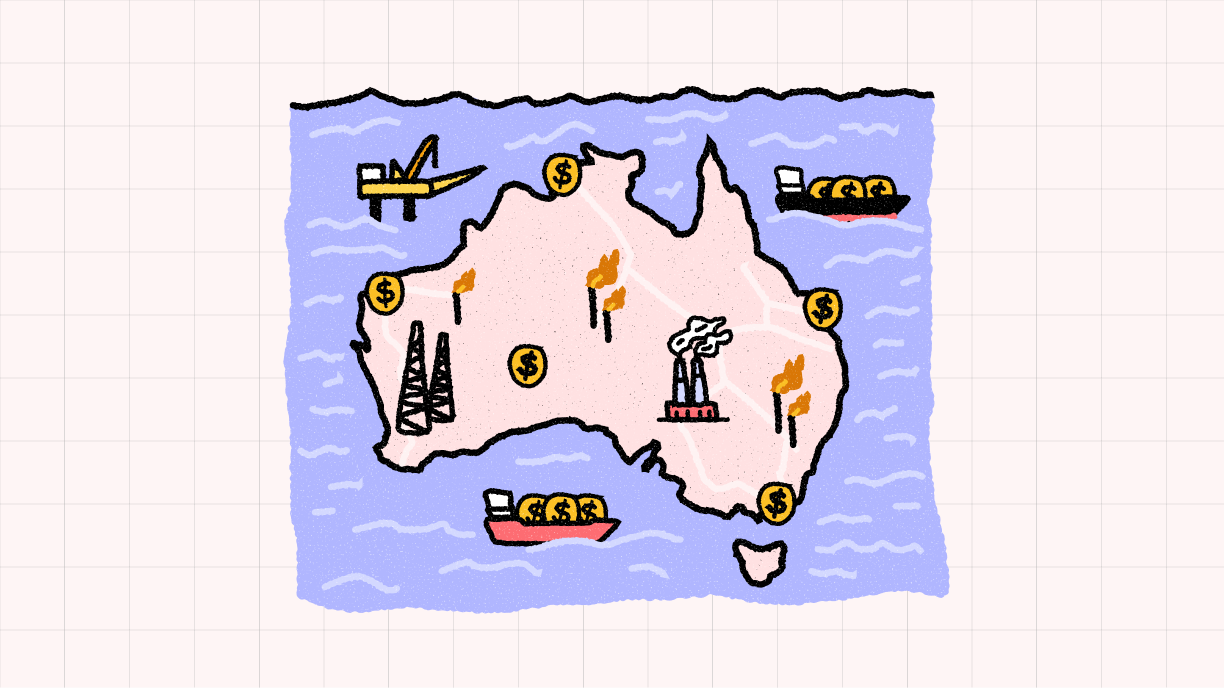
Australia exports vast volumes of gas each year — resources that are legally owned by the Australian public.
But unlike other major exporters, Australia captures only a small share of these profits. Countries like Norway and the United Kingdom return most of the value from their fossil fuel exports to the public. In Australia, much of that wealth flows offshore to foreign shareholders – even when export revenues soar. It’s a bad deal for Australians, and it’s one we can change.
The Fair Share Levy
The Fair Share Levy ensures Australians receive a fair return from their gas resources – based on the system that works so well for the Norwegian public.
It applies only when gas producers earn large, above-normal profits. Normal returns are left untouched, so investment incentives, jobs and competitiveness are preserved – and gas prices are not affected.
Policy Overview
A Norway-style levy on the large profits earned from Australia’s gas resources.
A small number of highly profitable gas producers and exporters. Because the gas industry’s profits are overwhelmingly exported to foreign shareholders, the tax burden of the FSL is primarily borne offshore rather than by Australian businesses.
Brings Australia into line with international best practice for taxing fossil fuel profits
Raises substantial public revenue without affecting future investment incentives, jobs, or increasing gas prices
Fixes the failure of the PRRT, which has been poorly suited to LNG and failed to capture expected revenues. These faults are widely recognised.
An FSL raises an average of $13 billion per year (2026–2050)
Reuben Finighan
Research Lead, Economic Pathways
Reuben holds a PhD in Political Economy from the London School of Economics and a Masters of Public Policy from the Harvard Kennedy School, as a Fulbright, Frank Knox, John Monash, and Leverhulme scholar. He has co-authored papers with Harvard Professor Robert Putnam, Ross Garnaut AC, and Lord Nicholas Stern, and previously worked at the University of Melbourne in applied economics and as Chief Economist for the Universal Commons.