The coming panel discussion is all about how we make the energy transition bankable.
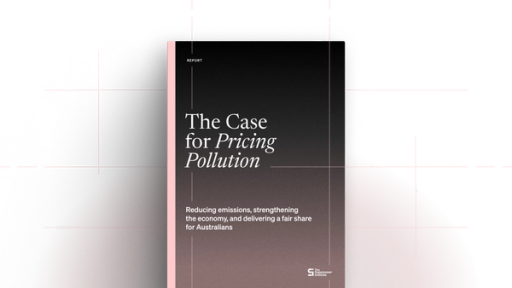
The answer is obvious. Australia needs a carbon price. The Superpower Institute has recently proposed a Polluter Pays Levy (PPL) starting at $17/tonne and then, by 2034, it would align with the European carbon price. It applies to 140 sites owned by less than 60 companies, and is levied on the carbon content of fossil fuels at the point of extraction.
We all know the logic. Without the carbon price, those producing zero or very low emission products must compete with high emission products with no allowance for the damage the latter products do to the environment.
The energy transition won’t happen without policy change because this is not a race between technologies starting the race together. Fossil fuel based production has a massive head start, made possible because it is not paying for the pollution it causes.
So there is no level playing field without a price on carbon.
There are only two reasons to oppose a price on carbon.
First, if you are unconvinced by the climate science.
Second, if you are concerned about the political reaction to a carbon price and so are willing to rely on much less efficient and effective mechanisms to reduce emissions.
As someone who lived through the 2012-2014 period it is not obvious at all that the then ETS was the cause of Labor’s defeat in 2014. Try rotating Prime Ministers; Rudd, Gillard, Rudd. The electorate saw a government fighting amongst themselves on one side and Tony Abbott who had clear and simple messages on the other.
Recent polling by Redbridge shows 68% support for the Polluter Pays Levy. Other polls show similar results. This is starting from a position of strength, not vulnerability.
Recent polling by Redbridge shows 68% support for the Polluter Pays Levy. Other polls show similar results. This is starting from a position of strength, not vulnerability.

But there is a much bigger point. The mechanisms we are currently relying on to reduce emissions are inefficient and do not have us on track to meet our targets.
Once you exclude emission reductions due to land use changes Australia’s emissions have barely moved at all since 2005. This is an amazing fact when we must reduce emissions in response to the dangers from climate change.
My key point is that I predict that Australia will have a carbon price soon; not this year but soon.
There are two drivers of this claim.
First, without major policy change Australia will miss its 2030 target and will miss by a long way its 2035 target.
Second, policies to boost emission reductions significantly beyond current levels will face way more political difficulties than the introduction of a carbon price. We either abandon our emission reduction targets, or we introduce a carbon price.
It is that simple.
The Government is currently relying on the Safeguard Mechanism (SM) and the Capacity Investment Scheme (CIS).
I commend the Government for its actions so far to reduce emissions. Making the Coalition’s SM workable was a good place to start.
But we must focus on the future, not the past.
The SM covers industries producing only 30% of emissions and works by setting a benchmark emission intensity for 200 odd facilities.
Many people have ideas to expand the SM so we can meet our emission targets.
The SM already suffers from the fact that is open to lobbying and industry will always find weak points in terms of soft emission intensity benchmarks. Expanding the SM beyond the current large players to thousands of smaller players so that it captures more of the country's emissions makes this problem worse, not to say impossible.
If the current SM has been effective it will often have raised prices for consumers, but the SM raises no money with which to compensate consumers.
On top of this we have the huge allocative efficiency issues that come with benchmarks set across very different sectors with differing levels of effectiveness.
Then some are arguing we should extend the SM to electricity with emission benchmarks to be met.
The problem is that this imposes an emissions constraint, which will raise the cost of generation, which will increase electricity prices for consumers. The problem is that the SM has no capacity to raise revenue to compensate consumers.
Extending the SM to electricity will be fiercely resisted. In an environment where the cost of living is already the number one priority, it is unrealistic to believe it can be implemented.
Under TSI’s PPL we raise $22 billion on average and, for 10 years, give back half the proceeds to insulate consumers fully from consequent price effects. This is in stark contrast to the SM which raises no money and so consumers suffer when price increases occur.
Under TSI’s Polluter Pays Levy we raise $22 billion on average and, for 10 years, give back half the proceeds to insulate consumers fully from consequent price effects. This is in stark contrast to the Safeguard Mechanism which raises no money and so consumers suffer when price increases occur.
Some argue that prices under the SM will not rise much; but then the SM is having little effect on emissions.
You could argue that for the SM to have any significant effect it would have to be reformed to look very much like an economy-wide carbon price. If you are going to do that why not do it properly?
Then we have the CIS. Some 40% of projects are solar and wind generation that are not dispatchable. The Government underwrites a price that is bid in by the project proponent. With negative daytime wholesale energy prices for large parts of each day and over the course of a year, the exposure of the government to price risk is significant.
The good news is that the price guarantee only underwrites the projects debt so the equity return is at risk. Perhaps that is why, so far, few projects are proceeding under the CIS; although it is early days.
The Nelson Review was to come up with recommendations that will replace the CIS. Commendably they link new projects to the market and underwrite prices beyond when there is a forward price market. But there is no price on carbon to encourage renewables, but only because this was explicitly excluded from their Terms of Reference. The Nelson recommendation for the ESEM, in partnership with a carbon price like the PPL, would be a powerful incentive for investment.
We have seen the Chair of the Productivity Commission courageously call for a carbon price even though the PC’s Terms of Reference for their recent five studies ruled out them recommending this. The PC Chair has found other ways of making her views known.
Likewise, the CEO of the Grattan Institute.
The problem Australia faces in our electricity sector goes beyond the task of reducing emissions, huge as that is.
Much of the existing coal fleet is at or near the end of life and one way or another needs replacing. Where will the new capacity we need come from?
No one will build nuclear, even if the ban is dropped, because it is ridiculously expensive.
Some dream of new coal fired power stations, but this isn’t 2004 when they were the cheapest source of power. And industry will not take the chance of a long term investment in a heavily polluting industry.
Gas is fine for peaking, but even this is being challenged by ever cheaper batteries. Australia’s gas prices are way too high for baseload gas generation.
We are left with renewables firmed by batteries and/or gas peaking generation. It is the cheapest form of new generation available. Indeed, Australia has likely the cheapest clean power in the world given our high quality solar and wind resources.
But new renewable energy cannot compete with existing old coal fired plants that have written off their investment years ago and only need to cover marginal cost. Many of these plants are being subsidised to continue. They need to generate fairly continuously and so can often bid in prices below solar and wind.
New renewable projects must also compete with projects underwritten by the CIS.
Future developments in the electricity market are hard to predict. But it is not unreasonable to say there is a chance that Australia will not build enough new generation to meet our needs, particularly with additional demand being driven by data centres.
What a disaster that would be.
Let me quote Richie Merzian, the CEO of the Clean Energy Investor Group, who made comments to the AFR yesterday. “It should be a boom time for renewables – 2026 is the year we need to start building things to hit the 2030 target. But you have investors frustrated at the fact that their pipeline of projects keeps hitting …. friction points. If you look at NSW, the biggest decision they have made this year is extending the life of the Eraring coal plant. This completely throws the case for investing in new renewables projects.”
I think that if there was a much stronger incentive for renewable investment these friction points may be better dealt with; indeed, I hear of renewable projects not proceeding mainly because of a lack of financial incentive to build them.
And we currently face a vicious cycle; insufficient renewable investment sees the need to keep coal plants open longer, which provides an additional disincentive to build renewables.
A price on carbon would address these issues.
Finally, some say that the Government can fund a range of new schemes to fund carbon reduction. But it cannot do this sustainably. Our budget problems are real. New emission reduction schemes will need to be budget neutral at best.
Back to my main point.
It is easy to oppose the introduction of a carbon price when the alternative is to do nothing.
But that is clearly not the alternative. New policies are necessary.
A lack of significant new policies will see prices rise for consumers without compensation, our emission targets not met, and a real chance of a shortage of new electricity generation.
A lack of significant new policies will see prices rise for consumers without compensation, our emission targets not met, and a real chance of a shortage of new electricity generation.
The proposed PPL not only allows us to meet our emission targets, and in the most efficient way, but it will also turbocharge more clean energy into the system.It will provide significant cost of living relief for households. And it can help reduce our budget deficit and also fund other needs like tax reform.
What other proposals can do all that?
The logic for a price on carbon is clear unless we are to give up on emission reduction. I do not think the Government will do that.
So, Australia will have a carbon price, not this year but soon.
Thank you for your time today.

Rod Sims
Chair, The Superpower Institute
Rod Sims is Enterprise Professor at the Melbourne Institute of Applied Economic and Social Research, Faculty of Business and Economics, University of Melbourne, and Chair of The Superpower Institute. He previously chaired the ACCC (2011-2022), served as Deputy Secretary (Economic) in the Department of Prime Minister and Cabinet, and Principal Economic Adviser to PM Bob Hawke (1988-1990).