The Bronze Age Apocalypse and Now
Contemporary disintegration of cooperative relations among states has encouraged us to think about the Bronze Age. The Bronze followed Donald Trump’s Stone Age. It was a time of civilised long-distance exchange of goods and ideas through the eastern Mediterranean, Persian Gulf and Red Sea to the Arabian Sea, and north through the Aegean into the Black Sea. It connected places in the Black Sea, the Levant and Persia that are now being bombed to misery, if not yet back to the Stone Age. It reached high points in Persia that are studied with respect in at least one great Chinese university, as the one large and complex civilisation older and more venerable than China’s own.
The Bronze Age was a time and place of invention, literature, art and prosperity. In these troubled times, we are intrigued by how it fell apart over less than half a century. Dalrymple and Anand’s Empire podcasts call the collapse “the Bronze Age Apocalypse”.
The Bronze Age Apocalypse included the mythologised destruction of Troy. Troy was wonderfully located for trade at the Aegean end of the Dardanelles. It was enriched from the same strategic geography that drew young Australians into the fatal shore that we remember reverently this weekend.
The Greek classics tell us that Cassandra saw and told of the Trojan Horse and collapse of Troy before it happened. The Trojans would avoid an awful fate if they accepted her prophesy, and left the horse alone in response to it. Cassandra was fated to be ignored. Her Trojan brothers rushed to haul the horse inside the city walls. The miseries followed her prophesy with painful faithfulness.
Australia’s Trojan Horse
Read again my book from 2013 and forgive my identifying with Cassandra. “Dog Days: Australia After the Boom” in 2013 was the first of the RESET Quintet. The fifth was “Let's Tax Carbon” in 2024.
Dog Days described how respect for knowledge and analysis in public discussion of policy choice through the last two decades of the twentieth century gave Australians an unprecedentedly long period of rising material standards of living. That successful approach to policy-making had weakened by the early years of this century. It was in advanced decay a decade later. Corporate and other vested interests had become more effective in shaping the public policy discussion and constraining policy choice. Pressures on the policy-making process encouraged focus on sectoral benefits over a wider public good. Change in the way we communicate across our society was favouring the immediate and divisive over the long term and integrative.
The looming repeal of demonstrably successful carbon reduction policies was the manifestation of what was wrong. Dog Days presented the polling data, that Labor’s carbon pricing had more public support than Abbott’s direct action on climate. That information is now buried by myth. It has suited both Labor and Coalition interests to promote the myth—Labor because the myth was more flattering than the reality of internal conflict that destroyed the electoral standing of the Rudd-Gillard-Rudd Governments.
The China resources boom sustained growth in Australian incomes for more than a decade after the end of Australia’s reform era a quarter of a century ago. Dog Days explained that the China resources boom was coming to an end. Restoration of policy reform in the public interest would now be necessary to avoid stagnation of living standards.
When “Superpower: Australia’s Low Carbon Opportunity”, was published in 2019, we were living the Dog Days. Productivity growth had slumped. Growth in real disposable incomes of ordinary Australians had fallen behind slumping productivity. Real existing climate change was increasing costs and uncertainty—as we were reminded in the unprecedentedly early bushfires in the Spring of 2019. The cost of insuring houses against climate damage had begun its long upward march. Other countries’ action to contain climate change was constraining investment in our big coal and gas export industries.
But Superpower also brought good news for Australians. The book described a tailwind that I had underestimated in my earlier work. The Superpower tailwind could help us if we set our policy sails to catch its power. As the world moves towards zero net carbon emissions, Australia’s rich renewable energy and plant-growing endowments make it an economically natural large-scale exporter of zero-carbon goods to countries that lack similar resources and opportunities. Australia can be the renewable energy Superpower of the emerging zero-carbon world economy.
As the world moves towards zero net carbon emissions, Australia’s rich renewable energy and plant-growing endowments make it an economically natural large-scale exporter of zero-carbon goods to countries that lack similar resources and opportunities.
Then COVID disrupted economic life. Economic activity collapsed, unemployment rose and anxieties emerged about supply of many goods. Economic policy had to adjust to radically changed circumstances. This could be the time to reset economic policy.
I sketched the opportunity and a plan early in the first COVID winter, in online public lectures from the central western Queensland town of Barcaldine. The lectures were published in 2021 as “RESET: Restoring Australia After the Pandemic Recession”. RESET defined Australia’s choice between post-pandemic Dog Days and restoration of prosperity. The new policies for the Superpower are developed in major research projects from the Superpower Institute on The New Energy Trade, A Green Iron Plan for Australia and taxation reform policies for carbon emissions and resource rents.
Three sets of policies are needed, all supported by standard economics. One is a premium price for goods produced with zero carbon emissions. The second is public support for innovation in producing goods without emissions. The third is public planning and incentives for network infrastructure for transportation of electricity and hydrogen. The dynamism of private market exchange is essential for success. That requires general policy rules that are known and understood by all market participants as they assess possible investments.
There has been some progress on policy to build the Superpower. Budget allocations support several categories of innovation. However, the absence of a general green premium constrains the contributions of dynamism through private markets.
Looking at the whole range of policy, so far we have implicitly chosen post-pandemic Dog Days over restoration of Australian prosperity. RESET has been too hard. Government debt grew. Productivity growth continued to languish. Workers’ real incomes fell further behind productivity. The Commonwealth and most state Governments adopted the Superpower as a slogan, without a full set of policies for its construction. A chasm opened between moderately strong targets for reducing emissions, and policies to meet them.
Since the Albanese Labor Government’s historically large victory in the 2025 elections, there has been discussion of deeper economic reform in the public interest.
Then came the US and Israeli invasion of Iran on 28 February 2026, the closure of the Strait of Hormuz, anxiety about fuel supplies, and a big increase in fossil energy costs.
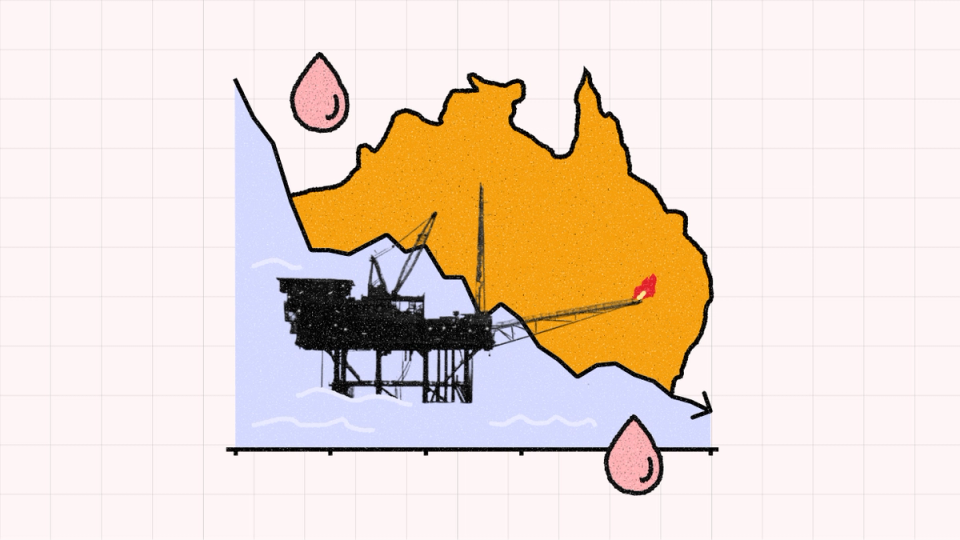
The fossil carbon interests built a Trojan Horse and left it outside Canberra’s Parliamentary Triangle. The Trojan Horse says that only one goal matters: security of supply for fossil fuels.
It argues that there should be no change in audaciously favourable taxation of methane gas income or sales, whatever the consequence for Australian economic resilience and Australians’ standards of living. There should be more fiscal support for old and new fossil carbon production and use, for example in petroleum refining. It demands repudiation of our commitments to net zero by 2050. It asserts that there is no Superpower opportunity.
The Commonwealth Government must make a fateful choice. It can open the gates for the Trojan Horse. Or it can recognise the Iran fuel security crisis as another chance to reset policy on combatting climate change, building the Superpower and restoring Australian prosperity.
The Commonwealth Government must make a fateful choice. It can open the gates for the Trojan Horse. Or it can recognise the Iran fuel security crisis as another chance to reset policy on combatting climate change, building the Superpower and restoring Australian prosperity.
Fuel Security and Other National Goals
Security in supply of important goods rose on the national agenda through the disruption of supply chains in the COVID pandemic. “National resilience” is the cry.
The liberalisation of Australian trade in the 1980s and 1990s made the largest single contribution to the lift in Australian living standards through the long economic expansion before the Dog Days. The partial reversal of that liberalisation is already contributing to lower productivity growth and stagnation of living standards. This is not an argument against all protection in the name of national resilience. It is a powerful argument for counting the cost, and limiting trade restrictions to commodities and degrees of self-sufficiency that analysis shows are demonstrably worth the cost.
Fossil fuels and urea fertiliser made from them have become the most prominent focus of calls for national resilience since the closure of the Strait of Hormuz. Are these products for which the gains from greater self-reliance are large enough to justify the costs? Maybe, if the costs are not too large. But let’s make our decisions on the basis of knowledge and analysis. And if we decide that there is a case for greater self-sufficiency, let’s select policies that work and impose the lowest possible costs.
The issues are similar for urea fertiliser and fuel. Self-sufficiency in green urea would require nearly one fifth the material inputs--renewable energy and biomass—of self-sufficiency in the green liquid fuel required to replace petroleum. Similar policies would be suitable for urea as suggested here for fuel. I will only discuss fuel from now on.
Fuel security matters. When it is at risk of large-scale failure, it can seem for a while to be almost all that matters.
The costs of seeking greater self-sufficiency are partly standard economic costs--rising prices for fuels, or larger public deficits or higher taxation. If greater self-sufficiency is achieved through local production and use of fossil fuels, the cost also includes the effects of higher Australian carbon emissions on the global fight against climate change.
The Trojan Horse wants us to forget the climate change costs. We had a substantial national conversation about the nature and costs of climate change nearly two decades ago. We could do with a refresher. Global temperatures will continue to rise until net global emissions fall to zero. Fail to get to net zero by 2050 and human-induced average temperatures continue increasing. The increase is already approaching a dangerous 1.5 degrees. Delay the achievement of net zero much beyond 2050, especially if the shortfall is large, and sooner rather than later climate change will move from being seriously costly as it is today, to being seriously destabilising for economic activity in Australia and for economic activity and political order in Australia’s neighbourhood.
Australia alone cannot achieve net zero. But we can help by being part of a cooperative international effort. We can do more by building the new Superpower industries that allow countries that are poorly endowed with resources for renewable energy and sustainably growing biomass to achieve net zero. The Superpower Institute has demonstrated that exporting our iron ore as green iron metal would reduce global emissions by about 4 percent—more than three times as much as reducing our own domestic emissions to net zero. Zero-carbon fuels and other metals together could be at least as important as green iron.
And we are not alone. The general tendencies in Europe, China and much of the developing world are reasonably favourable.
Our great and powerful friend across the Pacific is currently a drag on the global effort. However, there are cross-currents even in Trump’s America. Many state and municipal Governments support renewable energy and decarbonisation. US business is reducing costs and expanding markets by increasing renewable energy generation and use, and applying zero-carbon technologies to transport and industry. Naysayers say that the world will not get to net zero without active US Federal Government participation. They are probably right over the long haul. They are wrong to presume that the US Federal Government will maintain Trump positions forever. The US has been a leader of the global effort on climate change under four of the last six Presidents. The US is home to a high proportion of the world’s authoritative scientific physics. The US will not be constrained forever by Trump’s insistence that the science of physics is a hoax.
The facts are clear enough for those with eyes to read the scientific knowledge. The scientific analysis is more richly supported empirically now than it was two decades ago, with more direct observation of climate change.
Policy for Self-Sufficiency in Fuel and Fertiliser: How Far With Pure Green?
Should Australia seek to be much more self-sufficient in fuel and fertiliser supply, and if so, by how much?
My message so far is that the answer depends on how much it would cost. How much it would cost in standard economic terms, and how much it would cost in climate change.
Fuel may be an area in which both sets of costs are small so long as we use efficient policies. A high degree of self-sufficiency can probably be achieved while reducing emissions in line with targets and enhancing Australian economic growth, without increasing fuel costs over the longer term.
We don’t know the costs or the extent of fuel self-sufficiency for sure until we have established the incentives for new production and observed the response to them.
The “no regrets” starting point is three sets of incentives proposed by the Superpower Institute.
First, The Superpower Institute proposes a Polluter Pays Levy to introduce the green premium that compensates for the damage that emissions impose on other people. This secures the carbon emissions targets and reduces the budget deficit while reducing energy costs to households. As in Europe, carbon pricing would be supported by a carbon border adjustment mechanism. It also proposes a Fair Share Levy to raise large revenue from the undertaxed gas industry. This substantially strengthens the budget but does not contribute directly one way or the other to emissions, self-sufficiency and economic development goals. The two levies together with other measures anticipated for the May 2026 budget would radically improve Australia’s budget outlook. We would face a sea of international troubles with much greater confidence.
Second, The Superpower Institute proposes grants for the early users of new technologies and processes in Australia. These compensate for the benefits that pioneers of new technologies and processes confer on others through the knowledge generated by their work.
Third, The Superpower Institute proposes public coordination of and in some circumstances investment in transmission, electric vehicle charging and other network infrastructure.
The combination of high petroleum prices, as since the invasion of Iran, and The Superpower Institute’s policies, would introduce powerful incentives to use renewable electrical energy in transport and many industries. There would be a residual demand for liquid fuels. A combination of high fossil fuel prices and the proposed policies would provide powerful incentives for replacing petroleum liquid fuels by bio-fuels.
Coal, gas and oil are carbon and hydrocarbon compounds formed from the growth of plants millions and hundreds of millions of years ago. Anything that a hydro-carbon made from coal or gas or oil can do, can be done as well by a hydro-carbon made from new, non-fossil plant material and hydrogen from renewable energy.
Anything that a hydro-carbon made from coal or gas or oil can do, can be done as well by a hydro-carbon made from new, non-fossil plant material and hydrogen from renewable energy.
Do we have the sustainable biomass and green hydrogen resources for the substitutes for fossil fuels to be green? For green hydrogen. Australia can supply its own requirements and contribute a great deal to meeting the demand of other countries.
Let’s look at how far our bio-mass resources can take us.
Australia imports around 45 million tonnes per annum of liquid petroleum, mainly as refined products.
Amongst the liquid fuels, recent data show that about 57% is used in road transport (30 percent passenger vehicles, 12 percent light commercial and 15 percent heavy freight). About 14 percent is used in civil aviation (evenly divided between domestic and international). A few percent each is used in shipping and rail. The other big users are mining (about 14 percent) and agriculture (about 5 percent).
Liquid petroleum is currently being replaced mainly by renewable electricity in batteries. Perhaps three quarters will be replaced in that way once there has been time to turn over the stock of old machines. There is considerable scope for the balance to be replaced by green liquid fuels (most economically, hydrocarbons made from biomass and green hydrogen).
Capital costs of most electric vehicles are now close to internal combustion vehicles with similar capacities. Costs are continuing to fall. Fuel and maintenance costs are substantially lower for electric than internal combustion engines. Range disabilities are diminishing. With a carbon price at the European level, and economically rational provision of charging infrastructure, electric vehicles are likely to cover a high proportion of road and rail and of short-distance air and sea transport over the next decade or so. Mining and agricultural trajectories are not so clear. Fortescue Metals says that electrification of most mining equipment is commercially competitive at current international petroleum prices. Perhaps about 12 million tonnes per annum of liquid fuels would be required after the electrification that would occur by the end of next decade. Let’s err on the high side and say 15 million tonnes—one third of the current total. If the aim is to produce domestically 90 percent of the energy currently supplied by petroleum imports, and the electric vehicle contribution does not change, the biomass requirement would fall to about 9 million tonnes. Both the 15 million tonnes and 9 million tonnes would be greater to the extent that production processes rely on biomass without augmentation by hydrogen.
We would need about 5-8 million tonnes of bio-carbon to produce this mass of bio-fuels if we use hydrogen in production. This, in turn, would require about 10-16 million tonnes of dry biomass. Could we get that at a price that made bio-fuels competitive in the envisaged policy environment?
Costs are low for biomass that is a waste from other uses, and which is available in substantial quantities at single sites. It is also generally low for biomass exported from Australia for industrial and energy use.
Lauren Burns, Green Carbon Industries Lead at The Superpower Institute, currently estimates dry biomass availability at around 30 million tonnes per annum. This comprises about 10 million tonnes of crop residues other than bagasse from sugar refining; 4 million tonnes of dry bagasse; 4 million tonnes of forestry harvesting and sawmill residues; 6 million tonnes of canola seed, containing about 2.5 million tonnes of oil, much of it for biofuel production in other countries; nearly a million tonnes from fats, oils and greases; 5-6 million tonnes of dry wood chips; and about 3 million tonnes recoverable for industry from municipal waste. Much of this is waste at present. Use of canola, wood chips and fats would need to pay prices that are high enough to draw biomass from export sales. The value of bio-fuels in the proposed policy regime would generally make the diversion for local use attractive. Bagasse is generally an inefficient source of heat and electricity, and in Queensland and northern NSW could usually be replaced at relatively low cost from alternative renewable energy sources. Market competition would make biomass scarce and valuable and introduce incentives to draw it from wastes and low value uses into bio-fuel production. The economics would drive use of production processes drawing on hydrogen as well as biomass.
Provide incentives along the lines proposed by The Superpower Institute, and 10-16 million tonnes of dry biomass now from established, known and concentrated sources is not a stretch. The crude arithmetic suggests low-cost biomass would be available to produce all of Australia’s liquid fuel demand while making a start on exports of biofuels.
The larger Superpower export opportunity comes from sustainably growing biomass on land currently marginal to or outside agricultural use. The opportunities are very large in Australia, often drawing on native plant species that have not been commercially important up to now. Large-scale success requires environmentally and economically sound systems for measuring and rewarding the accretion of carbon stocks in soils and plants. This is necessary to make long-term investment in growing trees commercially viable. It also requires research, development and commercial innovation in biomass production. Australian agricultural, pastoral and forestry development has depended on high levels of publicly funded research since before Federation. The potential economic benefits from utilising this immense new opportunity for incomes growth in rural and provincial Australia warrants renewed Australian commitment to research, development and commercial innovation in development of a major new rural industry.
The potential economic benefits from utilising this immense new opportunity for incomes growth in rural and provincial Australia warrants renewed Australian commitment to research, development and commercial innovation in development of a major new rural industry.
A Policy Package for a Stronger Budget, Higher Living Standards and Fuel Security
A sound set of policy reforms in the May budget will recognise the inter-relationships between several objectives. We have to increase fuel security while reducing the budget deficit, increasing productivity, increasing the living standards of ordinary Australians, reducing carbon emissions, and building the zero-carbon industries that will sustain economic expansion as our coal and gas exports decline.
The Superpower package would allow us to do all of those things.
The Trojan Horse will disagree. The Trojan Horse will say that self-sufficiency in fuel requires massive expansion of domestic production and use of fossil carbon. Electrification of transport and industry will be at the margins. And zero-carbon fuels are a pipedream.
The Trojan Horse’s neigh is influential in the contemporary Australian political economy.
Let’s not let the argument end in stalemate in which we do nothing at all. If a high degree of fuel self-sufficiency is judged to have high value, we can be certain of achieving that outcome at the lowest possible cost if we add one extra element to the Superpower Institute’s policy mix.
Introduce a Fuel Security Mechanism to the Superpower Institute’s policy package and the market will decide the lowest-cost combination of locally produced fossil fuels and zero-carbon energy that meets the self-sufficiency objective. Let us presume that our policy-making processes have determined that a high degree of fuel self-sufficiency is worth the economic cost. Let’s say that 90 percent of what is currently imported petroleum should be supplied domestically by 2036. The Fuel Security Mechanism would allocate an import quota for next year, 2027, at 90 percent of the level of imports anticipated in the absence of policy change. That import quota would be diminished annually, to 10 percent of currently anticipated import demand in 2036 and subsequent years. The import quotas for next year and a proportion of the quota for later years would be sold by auction now.
Introduce a Fuel Security Mechanism to the Superpower Institute’s policy package and the market will decide the lowest-cost combination of locally produced fossil fuels and zero-carbon energy that meets the self-sufficiency objective.
The quota auction price would reflect expectations of the excess of domestic fuel production costs over international prices. It may generate large amounts of revenue in early years. It would generate much less revenue later over the decade because import volumes were falling, and lower still if, as I think is likely, costs of domestic production turn out to be low once production systems are well-established in Australia. A domestic market for import quotas would adjust to changes in expectations of domestic costs.
If the Trojan Horse is correct, we will see greater oil production and refining in Australia. We may even see conversion of coal and gas to liquid fuels. If I am right, most of the increased self-reliance will come from electrification and biofuels.
The balance between green and fossil energy would be determined by relative costs. The Trojan Horse would expect a brown outcome. I would expect overwhelmingly green supply.
Either way, the budget will have been greatly strengthened by the Polluter Pays Levy and the Fair Share Levy. Either way, the greater use of market incentives will have increased productivity in industries producing and using energy. Either way, emissions will have been reduced by the amount justified by the European approximation of the social cost of carbon—probably unrealistically low at present, but the closest we have to an economically rational carbon price in practice.
Neither the Trojan Horse nor I would favour self-sufficiency at any cost. I suggest that a limit be placed on cost by allowing imports above quota at a tariff rate that varies with the international price of crude oil. The tariff would fall to zero when international prices reach the peak levels reached in the Iran crisis. This would provide certainty to brown and green investors that the incentives for Australian production established by current prices are maintained. The Superpower Institute’s proposed mechanisms for compensating users of energy for the effects of the Polluter Pays Levy would reduce the impact on the standards of living of Australians on low and middle incomes. To the extent that imports above quota occurred under this regime, the self-sufficiency target would not be met. But the costs of the policy will have been contained.
Treating all fossil fuels as one may lead to much slower progress towards self-sufficiency for some specialised items—for example, civil aviation or shipping fuels. If that were thought to be a problem, limits could be placed on the volume of import quotas that could be used for particular types of fuels.
Other fine tuning could consider the contribution that exports of fuels make to national resilience by allowing a proportion of exports to earn rights to import quotas.
This set of measures would guarantee the targeted level of self-sufficiency unless costs of domestic production turned out to be unexpectedly high.
It would lead to a green solution unless the costs of electrification and of green liquid fuels turned out to be closer to the Trojan Horse’s expectations than my own.
It would lay the foundations for the Superpower unless domestic costs of zero-carbon fuels turn out to be much higher than I expect.
Security for International Partners
None of the measures proposed by the Superpower Institute would reduce investment in or raise the cost of exports of gas or coal. They therefore honour Prime Minister Albanese’s commitment that we will introduce no new tax that increases the costs of Australian coal and gas to regional trading partners.
The proposed package increases fuel security and lowers costs of decarbonisation of regional trading partners in several ways. In Chapter 11 of Let’s Tax Carbon I discuss the important role that Australia played in enhancing Japanese energy security after the Middle East oil crisis of the 1970s. We supported rapid and far-reaching diversification of energy supply away from oil from a problematic region to coal, gas and uranium from Australia. Australia replaced Saudi Arabia as overwhelmingly Japan’s main source of energy.
Australia’s emergence as a large-scale exporter of zero-carbon fuels supports an even larger diversification towards more stable energy sources in our Asia Pacific trading partners.
We could make one additional contribution to regional economic security. We could invite neighbouring countries to enter our system of national resilience. Papua New Guinea and East Timor could benefit substantially from participation. Indonesia, Malaysia and others would be welcome. Singapore would want to join us, in ways that did not compromise its trade relations with the rest of the world.
Heeding Cassandra
The Trojan Horse is attractive after a long and exhausting war. It asks no stretch of imagination, relying only on familiar sources of energy and technologies. It delivers benefits to established businesses and workers rather than to firms and workers who do not yet know who they will be. But it closes off large opportunities for progress on all of Australia’s economic problems: the budget deficit; productivity and economic growth; living standards; and defeating climate change.
Cassandra is accustomed to being heard, rejected and proven right. It would be good for Australia to surprise her in the May budget.

Ross Garnaut
Director
Ross Garnaut AC is a renowned economist specialising in development, economic policy and international relations. He is Professor Emeritus at the University of Melbourne and a Fellow of the Australian Academy of Sciences. His contributions to trade policy and climate change have made him a trusted adviser to successive Australian governments.