
Western Australia has built great export industries before. Jessica Shaw, TSI's Western Australia Program Director, explains how that industrial muscle memory can help build the next one. Read more about WA's industrial history.
Why WA. Why now?
The global conversation about decarbonising steel often focuses on ‘green steel’, the finished product. But for Western Australia, the opportunity lies upstream: in producing green iron, the clean metallic feedstock that steelmakers need to transition away from coal-fuelled blast furnaces.
Steel is responsible for more than 8% of global greenhouse gas emissions. The major share of these emissions are produced during the ironmaking step where iron ore is converted to iron metal. Scrap is a valuable resource and will play a growing role, but it cannot meet total demand. This means primary steel production will remain essential for decades. The challenge is to decarbonise it.
Western Australia supplies around 60% of the world's seaborne iron ore trade. Its iron ore industry has supported decades of economic growth, built deep trading relationships and established the State's reputation for delivering complex industrial projects at scale.
Four advantages provide a foundation for green iron development:
- Renewable energy: World-class solar and wind resources with the potential to underpin competitive electricity and hydrogen production.
- Iron ore: Substantial hematite and magnetite resources across multiple regions, suited to different green iron production pathways.
- Markets: Long-standing relationships with major steelmakers in Japan, Korea, China and beyond.
- Delivery capability: A proven history of coordinating infrastructure, investment and industrial development.
Together, these give WA a credible foundation to move beyond raw ore exports to green iron production – using its abundant renewable energy to make higher-value products for global markets.
This shift can support long term regional jobs, deepen local manufacturing capability and create genuine opportunities for Traditional Owners.
But the opportunity is not guaranteed. Global decarbonisation is reshaping the requirements of steelmaking, carbon pricing is changing markets, and competing regions are moving quickly. With iron ore royalties contributing roughly a quarter of State revenue, developing a green iron industry is both a major economic opportunity and a hedge against the erosion of WA's largest industry.
Western Australia's industrial 'muscle memory' provides valuable experience in coordinating infrastructure, managing approvals and attracting investment. Rebuilding and applying this capability will be essential to delivering a new green iron industry as Western Australia positions itself for a more diverse and resilient industrial economy.
What shapes green iron development?
Green iron production is not simply an extension of Western Australia's iron ore export industry. It is a fundamentally new industry, one that will require adapting and scaling emerging technologies, developing new commercial models, and building relationships in unfamiliar markets. In doing so, it will create opportunities for partnerships between new entrants, established miners and international steelmakers.
Differences in ore types, technology readiness, energy systems, infrastructure and delivery capability affect the cost, risk and timing of green iron development. Six considerations help explain where and when projects may become viable in Western Australia.
1. Markets
Who will buy green iron, and when?
Early green iron markets are expected to be concentrated in high-value segments of the steel industry. Automotive, specialty, defence and advanced manufacturing supply chains are moving first, driven by corporate net-zero commitments, supply-chain emissions reporting and compliance requirements. Europe, Japan and Korea are likely first movers. Initial volumes will be modest but strategically important.
At volume, however, green iron is a transitioning market. Large-scale demand depends on the transition of the Chinese steel industry, the world’s largest, as ironmaking is separated from steelmaking and imports of iron ore and coal give way to imports of iron. China’s slower pace explains why very large-scale demand is a longer-term prospect.
2. Ore
Which ores suit which pathways?
Different ore types suit different production pathways. The Mid West has substantial magnetite resources, some of which may be beneficiated – processed to remove impurities – into high-grade concentrates suitable for direct reduction ironmaking. The Pilbara’s predominantly hematite ore is difficult to beneficiate to direct-reduction grade, but its vast resources are central to the opportunity for long-run scale.
Ore characteristics constrain technology choice, and the costs of processing different ores affect energy requirements and project economics.
3. Technology
What can be deployed now?
Most commercial-scale green iron projects globally use, or plan to use, vertical shaft furnace technology adapted for hydrogen. The technology is mature using natural gas, but hydrogen-based production is not yet operating at commercial scale. It requires high-grade pellets or suitable lump ore.
Emerging technologies, including fluidised bed reduction, flash reduction, electric smelting and iron electrolysis, will unlock the use of iron ore fines and lower-grade ores for green iron production. Their readiness varies, and some require further demonstration and de-risking before commercial-scale investment. Technology maturity therefore affects regional timing and early mover risk.
4. Energy
How will projects access reliable, low-cost renewable power?
Green iron production requires very large quantities of renewable electricity, including for hydrogen production. TSI’s modelling highlights energy system configuration as a major cost driver.
The Mid West has access to the South West Interconnected System (SWIS) and the Wholesale Electricity Market (WEM). Where network capacity and connection arrangements allow, this can reduce the generation and storage a project must build, principally by providing firming supply. The Pilbara’s North West Interconnected System and other private networks do not provide equivalent access to a wholesale electricity market. Projects there may require substantial dedicated generation, storage and firming capacity, increasing upfront costs.
A supply of affordable green hydrogen is not yet available at the volumes early projects need. Coordinating hydrogen production, storage and demand with the first green iron projects, including links to Commonwealth hydrogen programs, is therefore an immediate delivery priority.
5. Infrastructure
What exists, and what must be built together?
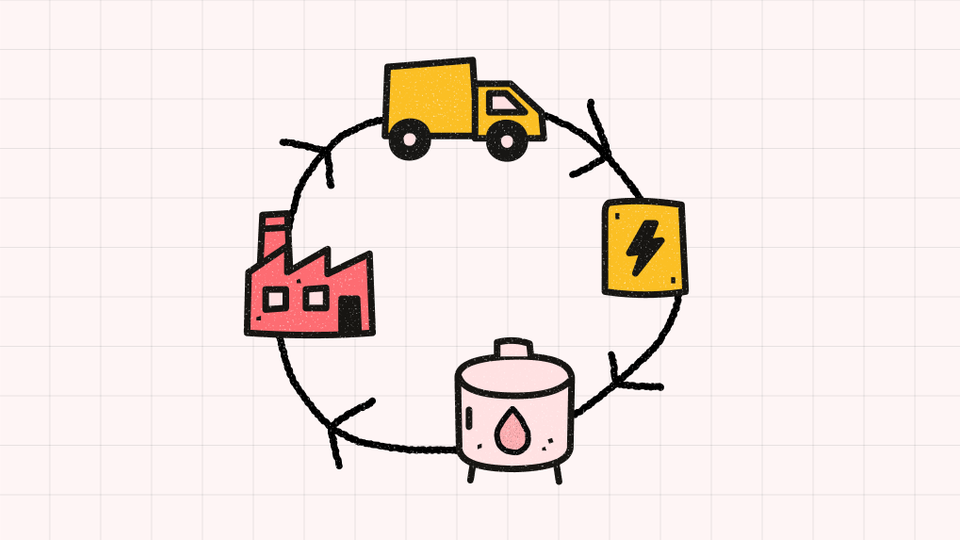
Green iron development depends on the successful integration of multiple delivery systems. Energy supply, water infrastructure, ports and logistics, workforce and skills, planning and approvals are all potential bottlenecks. Large-scale systems may need to be developed ahead of demand and at a scale that exceeds the needs of any single project.
Early projects can benefit from existing or readily adaptable infrastructure. Scaling up an industry will require coordinated investment in transmission, desalination and water pipelines, ports, roads and rail, and potentially shared hydrogen systems.
6. Delivery
Who can bring projects and partnerships together?
Cost comparisons alone cannot determine whether projects succeed. First-mover risk, commercial relationships, infrastructure coordination, technology learning, workforce capability and social licence all matter. Proponents’ project readiness and ability to attract private finance are important, as are effective Traditional Owner partnerships and predictable approval processes.
Western Australia has a long track record of delivering large-scale industrial developments. Rebuilding the State’s institutional ‘muscle memory’ in coordinating infrastructure, approvals and investment is central to applying that experience in a new industrial context.
What the WA modelling shows
TSI has undertaken modelling to reflect Western Australian conditions in the Mid West and Pilbara. The scenarios compare green iron production at the Oakajee and Boodarie Strategic Industrial Areas, including differences in ore characteristics, technology, energy systems and regional costs.
Three key findings emerge:
Grid access materially reduces costs, mainly by firming supply
In the modelled Mid West scenarios at Oakajee, a grid connection lowers costs mainly through firming, rather than through earning revenue from electricity exports. For the scenario where the plant runs continuously and uses direct-reduction-grade magnetite, a grid connection of around 300 MW reduces costs by more than A$80 per tonne compared with no grid connection. The most suitable connection size depends on the project’s technology and operating profile.
Ore quality and technology affect energy demand
Higher-grade iron ore can reduce the processing and energy requirements of green iron production, lowering overall costs even where the ore itself is more expensive. Where lower-grade ore is used, the addition of a smelting step increases costs for both flexible and inflexible technology types.
Location significantly affects production costs
In the scenario where Pilbara hematite is shipped to Oakajee in the Mid West for processing, the costs are between A$360 and A$731 per tonne less than processing it at Boodarie in the Pilbara for the flexible and inflexible technologies respectively. The differences reflect the off-grid configuration and higher locational cost factor modelled for the Pilbara.
The modelling compares costs under specific assumptions; it does not assess individual projects or predict investment decisions. Factors such as market access, proponent capability, first-mover advantages and the value of coordination also matter.
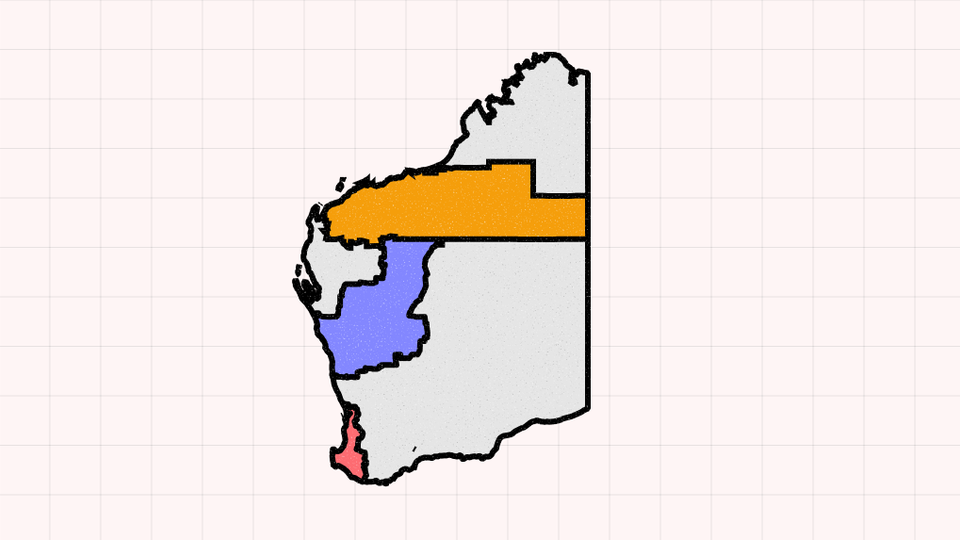
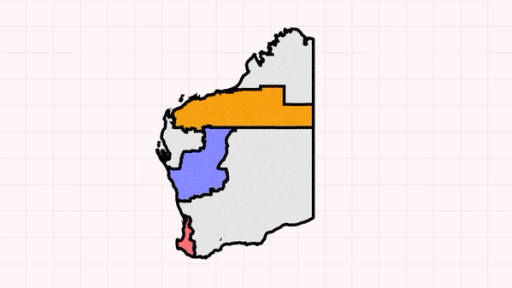
Three regions, different roles
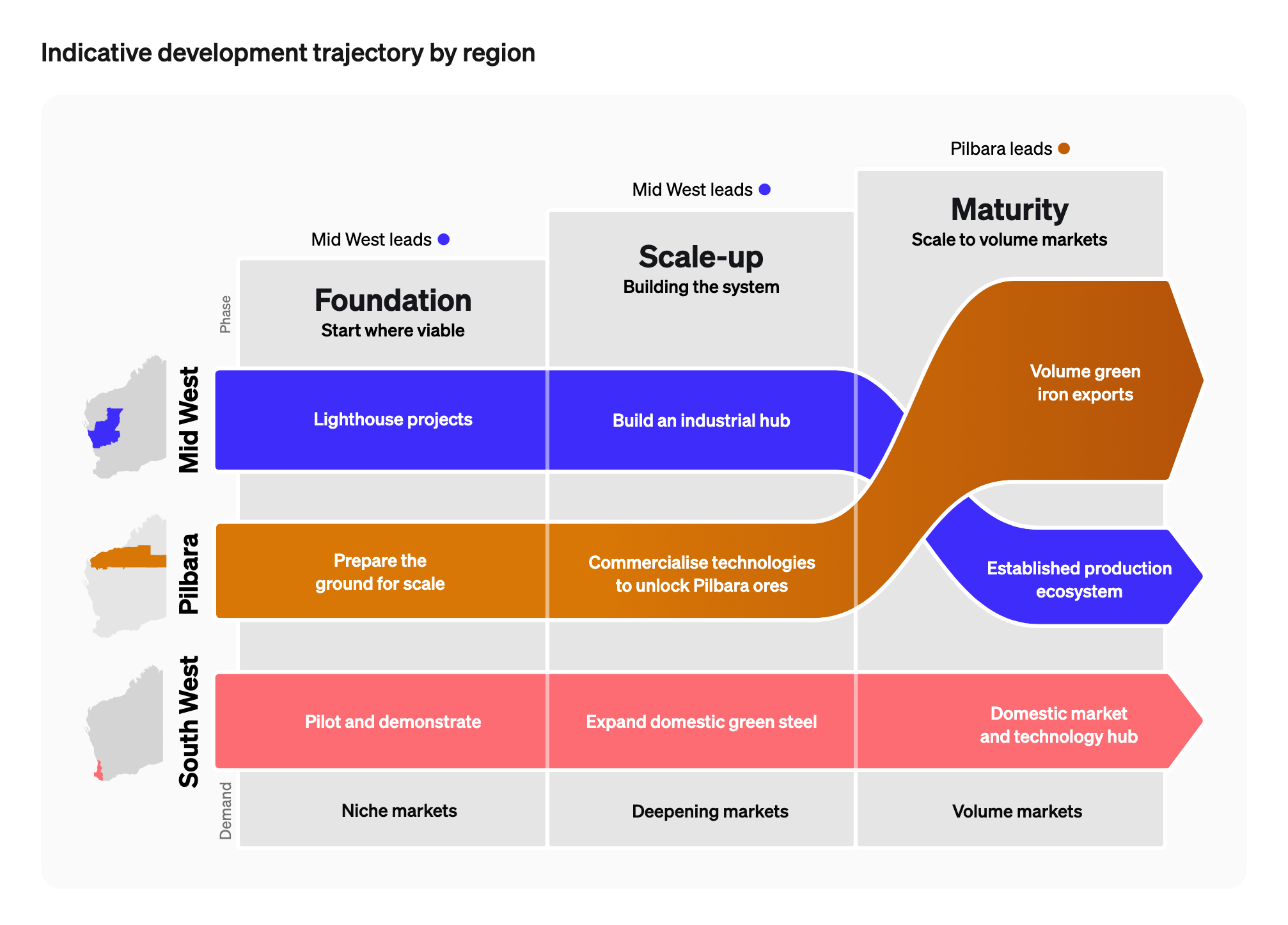
The Roadmap identifies an indicative development trajectory with three phases – foundation, scale-up and maturity – distinguished by market conditions, technology deployment and infrastructure expansion.
These phases will not unfold in the same way across Western Australia’s regions. Green iron industry development requires the Mid West, Pilbara and South West regions to progress in parallel, employing their existing advantages in ore, technology, energy systems and infrastructure. This trajectory is a guide to government coordination and investment, not a commitment to specific projects or locations.
The Mid West
The Mid West hosts over 8 billion tonnes of identified magnetite resources. Depending on individual deposits, magnetite ores can be beneficiated to produce concentrates suitable for established direct reduction pathways.
TSI's modelling indicates that the Mid West likely offers the lowest cost of entry to first-of-a-kind commercial green iron production in Western Australia. Major critical factors already exist – brownfields transport and export infrastructure, grid access, local magnetite supply chains, a nearby workforce and excellent renewable energy resources.
During the foundation phase, the Roadmap recommends support for one or two lighthouse projects using proven direct reduction technology, local ore and existing infrastructure. However, the Mid West is not 'shovel ready' at scale. Substantial investment in transmission, water, transport and port capacity will be required to scale beyond these early projects.
To capture the spillover benefits from first-of-a-kind projects, the focus should shift towards developing a fit-for-purpose industrial hub, leveraging existing planning at Oakajee for port upgrades, desalination, transmission and enhanced road and rail. Over time, an established production ecosystem and supply chains can benefit from economies of scale, increasingly led by private investment.
The Pilbara
The Pilbara hosts an estimated 56 billion tonnes of hematite resources and an established, globally significant iron ore export industry. Because Pilbara hematite cannot be easily beneficiated to direct reduction grade, it faces a more complex pathway to green iron production.
The combination of off-grid energy systems and remote infrastructure development creates a very high capital threshold for Pilbara green iron projects. The Pilbara's challenge is not scale or resource availability, but near-term cost.
Long-lead enabling work should begin during the foundation phase, in parallel with early projects elsewhere. This includes coordinating project-ready land, heritage approvals, transmission construction and access arrangements, and developing financing models for delivery. Small to mid-scale commercial demonstration projects suited to Pilbara hematite ores may also emerge in the region during this phase.
As markets deepen and technologies mature, the focus shifts towards commercial-scale processing of Pilbara ores and the expansion of shared infrastructure.
Ultimately, the Pilbara is central to supplying future volume markets, particularly as China's steel industry transitions from importing iron ore and coal towards importing green iron. Large-scale Pilbara iron ore production could increasingly be diverted from direct shipping to domestic green iron production, drawing on the region's established infrastructure and long-run renewable energy potential.
The South West
The South West's role is fundamentally different from the two iron ore regions. Energy market access, established industrial precincts, proximity to labour markets and research institutions, scrap availability and domestic demand make it suitable for technology pilots and demonstrations, green steel market development and workforce capability building.
In the foundation phase, the Roadmap envisages continued support for technology pilots and demonstrations, particularly at Kwinana, alongside developing workforce skills, building social licence and creating a domestic market for green iron. No commercial-scale green iron production is expected at this stage.
As the green iron industry scales, the South West can expand domestic green steel production and the scope of technology demonstration. Over the longer term, it can become a domestic market and technology hub, supplying skills, training and technology products and services to the broader industry.
The role of government
Markets will not, on their own, deliver an efficient transition to green iron production in Western Australia. The absence of effective global carbon pricing weakens incentives for low-emissions production; early movers cannot fully capture the value of technological learning; and shared infrastructure is unlikely to be delivered efficiently project by project. System-level coordination and sequencing challenges compound these market failures.
The appropriate role of government is not to replace private investment, but to enable it through coordination, policy certainty and capability building. Public infrastructure investment should address assets with public-good characteristics and reduce system-wide risk, rather than underwrite project-specific commercial risk.
Government also has a role in developing international markets, through trade engagement, standards and certification, and relationships with overseas buyers.
Three principles should guide government support
- Enable rather than substitute for private investment.
- Sequence intervention based on readiness and risk.
- Preserve optionality and avoid lock-in.
The Roadmap also proposes a project assessment Scorecard to guide where government focuses its limited coordination and infrastructure effort. It is intended to give government a consistent, transparent way to assess project fundamentals, strategic value and delivery capability across criteria including hydrogen supply, offtake, shared infrastructure benefits and Traditional Owner partnerships. It supports judgement; it does not replace commercial due diligence or regulatory assessment.
Public support, coordination and policy facilitation should be directed to electricity- and green hydrogen-based production pathways capable of near-zero emissions. A project’s decision to start on gas is a commercial choice that should be commercially funded. Government should not subsidise gas use or fund gas infrastructure for ironmaking. Projects that start on gas may still receive coordination and support for their green-production capability, with incentives tied to qualifying green production rather than government-managed transition milestones.
From roadmap to action
In the near term, government effort is most effectively directed towards actions that will support a small number of green iron projects already under development in Western Australia.
The demonstration effect, market development and broader knowledge generated by these projects can deliver benefits beyond their individual commercial outcomes. At the same time, long-lead enabling work should begin in the Pilbara, preparing the region for future large-scale production.
Immediate priorities for government action include:
- Rebuilding and resourcing the State's institutional coordination capability
- Identifying, scoping and coordinating enabling infrastructure for a Mid West industrial hub
- Improving information flows through engagement with industry proponents
- Supporting processes that reveal domestic market information, including tenders and expressions of interest
- Coordinating hydrogen supply planning with early green iron projects and Commonwealth hydrogen programs
- Developing a workforce training and investment strategy ahead of demand
- Beginning long-lead enabling work in the Pilbara required for later scale
Large-scale infrastructure investment, long-term production support and location-specific commitments should remain conditional on market responses and evolving technology and project proposals.
The Roadmap is not a commitment to particular projects or locations. It provides a framework for making informed decisions as markets, technologies and opportunities evolve.
Western Australia has a credible opportunity to lead in the global transition to green iron, but success is not automatic. Acting early, coordinating deliberately and adapting as information improves will give the State its best chance of turning that opportunity into an industry.